Profit and growth are top of mind for every brand or business. Regardless of how people-centric your company is or wants to be, it first and foremost wants to grow and that’s okay.
The challenge is that growth is in people hence the need to continuously refresh your talent management skills and initiatives.
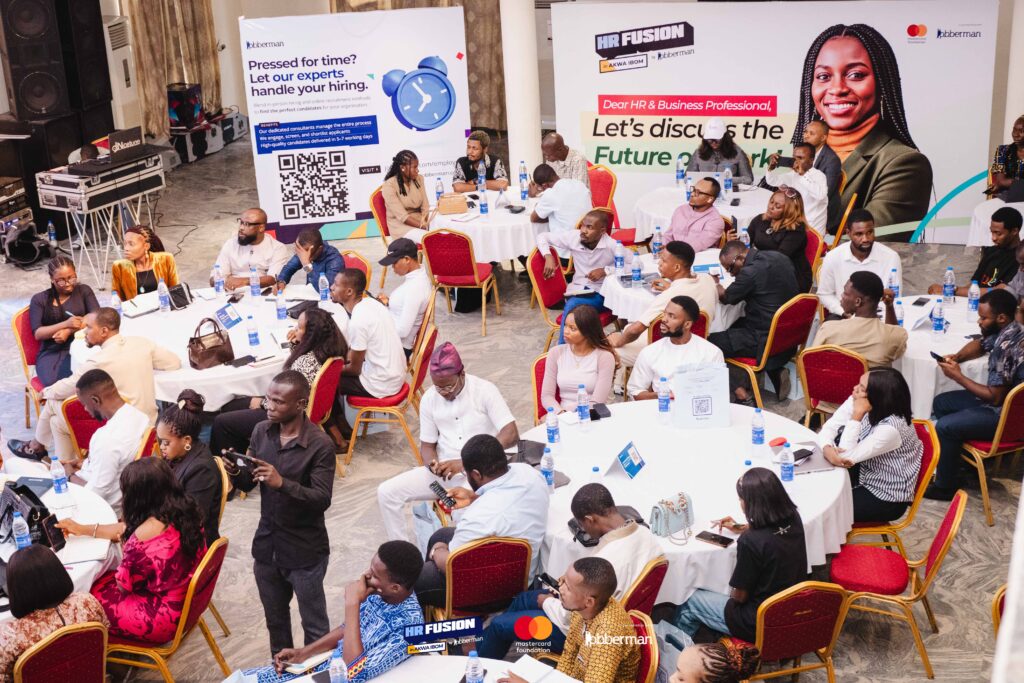
On Friday, the 26th of September, Jobberman Nigeria, Jobberman Nigeria in partnership with the Mastercard Foundation hosted the HR Fusion by Jobberman in Akwa-Ibom. The event features a theme exposition, and a breakout session.
Talks about talent management for business growth kicked off with the keynote speaker giving a thorough theme exposition.
During his keynote speech, Mr. Ide Owodiong–Idemeko noted that effective talent management begins with aligning people with business strategy, not just hiring talent but placing “the right people, in the right roles, supported in the right way.” He underscored that businesses in Akwa Ibom must treat talent as a strategic driver of growth, not an HR formality. The five pillars he outlined were strategic alignment, attraction, development, engagement, and technology, which form the foundation of sustainable business success.

He stressed that growth happens when organisations develop, empower, and retain talent through learning and engagement. Quoting Richard Branson, he reminded leaders to “Train people well enough so they can leave, treat them well enough so they don’t want to.” He urged HR professionals to act as business partners, leveraging technology, data, and inclusive strategies to build a workforce that fuels innovation, competitiveness, and economic transformation in Akwa-Ibom and beyond.
After the speech, there was a breakout session. Some of the highlights from the breakout sessions are as follows.
Table of Contents
Hiring practices remain largely exclusive.
9 out of 10 employers do not actively seek to hire individuals from marginalised groups, despite the 5% quota requirement.
True inclusion requires shifting focus toward recognising the value and abilities these individuals bring to the workplace.
This lack of intentional recruitment often stems from misconceptions that hiring marginalised groups may affect productivity or require excessive accommodation. However, research and workplace evidence show that diverse teams are more innovative and resilient. By ignoring marginalised groups, organisations miss out on a wide pool of capable talent who could contribute significantly to business growth.
Breaking bias against people with disabilities.
Organisations must consciously work to remove mental biases against persons with disabilities (PWDs). Creating a culture that celebrates their contributions, for example, dedicating special recognition days, helps normalise inclusion.
Bias is often subtle, such as assuming PwDs cannot handle leadership roles or complex tasks. Changing this narrative requires both awareness campaigns and structural changes, like providing accessibility tools and training managers on disability inclusion. Celebrating contributions publicly also shifts the culture from sympathy to respect, reinforcing the idea that PwDs are assets, not liabilities
Creating safe spaces for women and PWDs.
Workplaces should establish fair systems to address harassment cases and ensure HR is equipped to respond appropriately. A culture of respect for all, men, women, and PwDs, should be visibly demonstrated at every level.
Beyond policies, organisations need practical mechanisms such as anonymous reporting systems, clear anti-harassment guidelines, and regular sensitisation sessions for all staff. Safety also extends to physical accessibility ensuring offices, facilities, and technologies are inclusive. When employees feel genuinely safe, they are more engaged, productive, and loyal to the organisation
Managers as role models of inclusion.
Managers play a central role in shaping behaviour within organisations. By modelling fairness and inclusivity, they set the tone for their teams. HR, as gatekeepers, must be intentional in how they lead so others follow.
Employees often take cues from their managers’ behaviour, meaning inclusivity must be demonstrated in everyday actions like assigning projects fairly, giving equal opportunities for promotion, and addressing bias in team discussions. Accountability is key: managers should be evaluated on their inclusivity as much as on their technical results. This ensures inclusion is not just HR’s job but a shared leadership responsibility
Recognition and employee experience.
Investment in employee experience, especially through recognition programmes for PwDs, reinforces a sense of belonging and motivates performance.
Recognition can go beyond awards. It includes creating platforms where employees with disabilities can showcase their skills, receive mentorship, and access growth opportunities. A supportive employee experience builds confidence and reduces turnover, while also signalling to external stakeholders that the organisation values inclusivity as a core principle.

Inclusive recruitment strengthens businesses.
Building recruitment systems that actively include young persons with disabilities creates more dignified workspaces while also strengthening businesses with diverse talent and perspectives.
An inclusive recruitment process widens the talent pool and fosters innovation by bringing diverse perspectives into problem-solving. It also strengthens the company’s reputation, making it attractive to socially conscious clients, investors, and partners. In the long run, inclusion is not only a moral imperative but a business advantage that drives sustainability and competitiveness.
With these tips and initiatives in place, businesses can effectively manage their talent and the ripple effect is growth across board.
Meanwhile, if hiring top talent that will drive business growth in your organisation has been challenging, let Jobberman come to your rescue.
We have over 3 million qualified candidates across several industries ready to be hired. You can hire for FREE by listing your vacant roles on our platform.
You can also train the talent you have to do much better with our FREE Soft Skills training.
If you require assistance of any kind in recruitment, feel free to speak with our representative by sending an email to info@jobberman.com.